


Next: Experimental Results
Up: Shape Reconstruction
Previous: Image-based 3D Reconstruction
During the past decade, PDE-driven surface evolution has become very popular in the computer vision community for the purpose of shape recovery and object detection. Most of the existing work is based on the Eulerian approach, i.e., the geometry and topology of the shape is implicitly defined as the level-set solution of time-varying implicit functions over the entire 3D space [25]. The desirable shape must be explicitly evaluated using marching-cube-liketechniques [24] in the additional post-processing stage. To reduce the computational cost related tothe higher dimension, algorithms such as the narrow band algorithm [16] have been proposed by researchers. In[12], Ye Duan, Liu Yang, Hong Qin and DimitrisSamaras proposed a PDE-based deformable model that, in contrast, takes the Lagrangian approach, i.e., the geometry and topology of the deformable surface are always explicitly represented throughout the simulation process. The elegance of our approach lies in the fact that the same PDE-based model is used for different types of data, such as 3D point clouds, volumetric data and 2D images. The only thing that is data-dependant is the control function, which describes the interaction with the data. This is an important property that will allow easy application of our methodology to other types of data, such as points, surfels,images and to incorporate other visual cues such as shading and optical flow. To ensure the regularity of the model and the stability of the numerical integration process, powerful Laplacian tangential smoothing, along with commonly used mesh optimization techniques, is employed throughout the geometric deformation and topological variation process. The new model can either grow from the inside or shrink from the outside, and it can automatically split to multiple objects whenever necessary during the deformation process. Compared with level-set based methods, the new model is simpler, more intuitive, and makes it easier to incorporate user-control during the deformation process. More importantly, our model supports level-of-details control through global subdivision and local/adaptive subdivision.
Here are the work flow of the deformable surfaces:
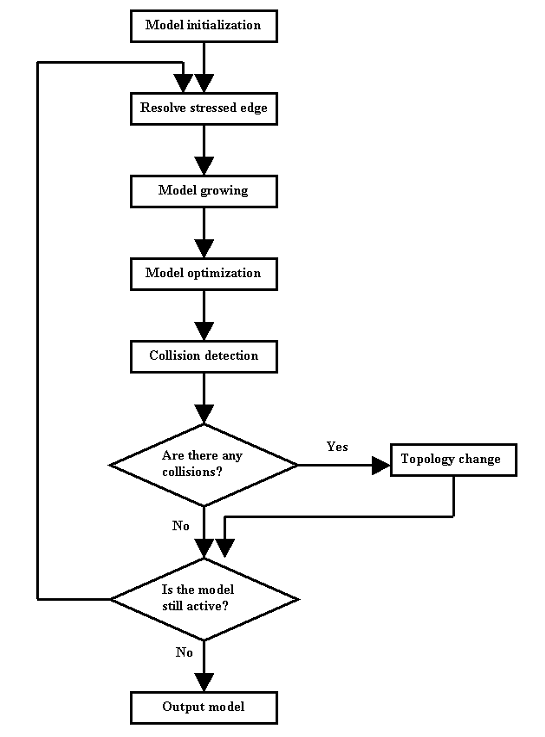
(For more detail and results, you can check here).
Next: Experimental Results
Up: Shape Reconstruction
Previous: Image-based 3D Reconstruction
Liu Yang
2004-06-18