


Experimental results show that the new model can generate a good, high-quality polygonal mesh that can capture underlying topological structure simultaneously from various data sets such as volumetric data, 3D unorganized point clouds and multiple view images. The explicit representation of the model enables us to check for visibility and camera pose directly and easily through the appropriate control function.
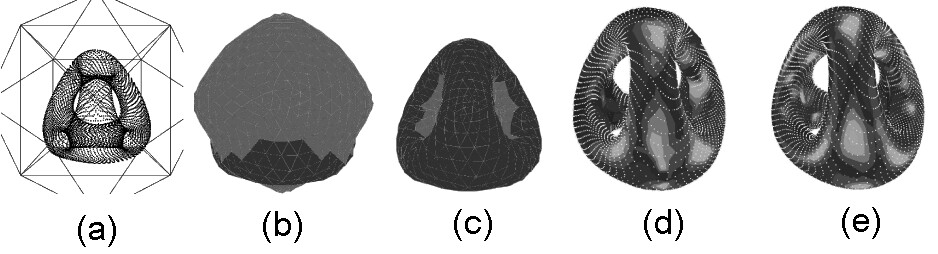
Figure 1: Reconstruction with Topology change. (a) model initialization; (b) (c) during deformation, dark area stands for non-active, while grey is active; (d) final shape; (e) one level of refinement
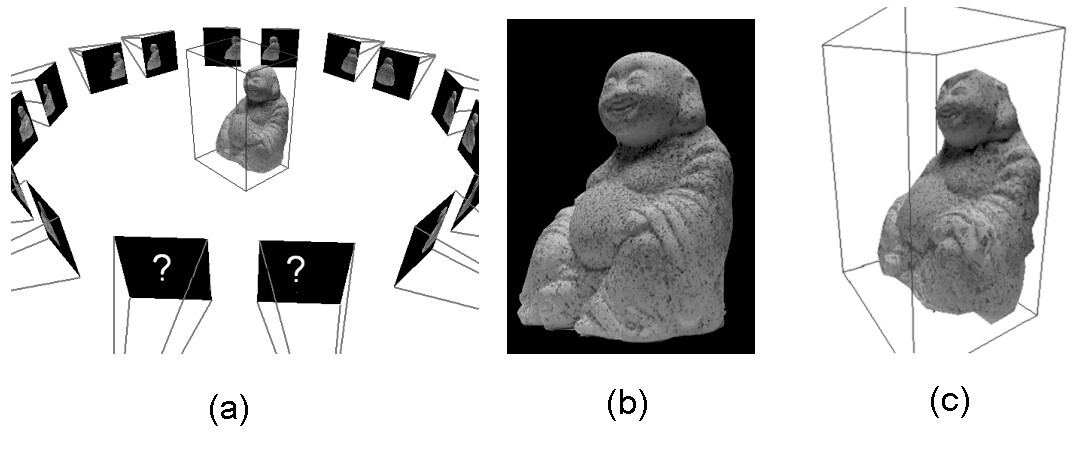
Figure 2: (a) position of 16 real images of Buddha, the 2 images with question marks were not used in the reconstruction, one of them is shown in (b); (c) final textured mapped mesh rendered from a similar view point as images (b).
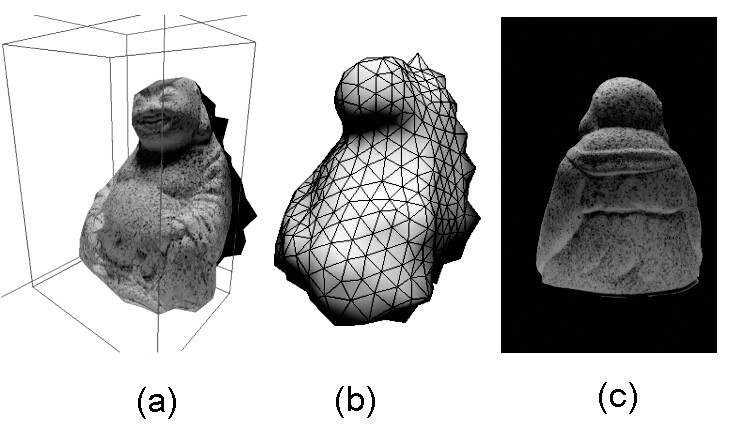
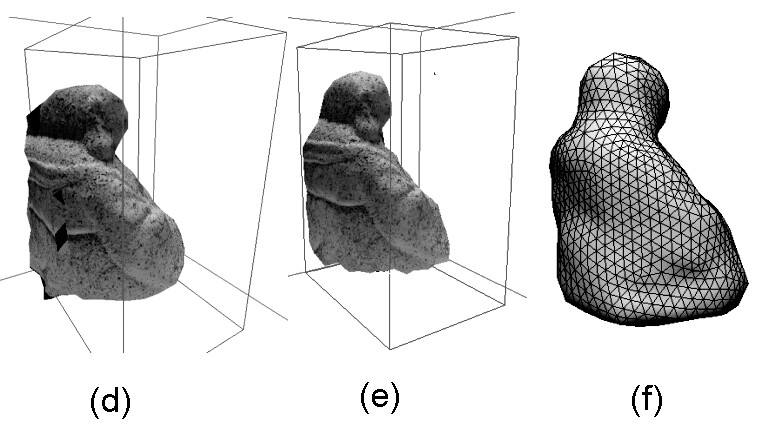
|
Figure 3: Incremental reconstruction. (a): partial reconstruction result from 6 frontal images (Black area is not recovered due to lack of image of the data for that part of the model ); (b): untextured fitting mesh of (a); (c): one of the 5 images (back views) added later; (d): intermediate result after adding more images; (e) complete reconstruction result; (f) mesh result of (e).