One-address systems: PDP10
Few of the computers classed as one-address systems have strictly
one-address instruction formats, although these were traditionally
fairly common among minicomputers and early microcomputers where
economy of bits in instructions was vital. The DEC PDP-10
[1], for example, had
a single store address within each instruction, but also specified one
of sixteen identical, general purpose registers, rather than assuming
a single implicit accumulator.
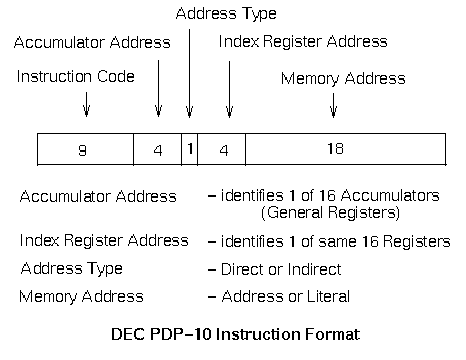
Figure 4. PDP 10 instruction format
One-and-a-half-address might
be a more appropriate designation for this type of instruction, and
clearly the IBM System/360 RX format (described under Two Address
Systems) would fall into this category. Instructions in MU5 (see
under The MU5 instruction set), on the other hand, and its
commercial derivatives, the ICL 2900 series and Series 39, can be
regarded as strictly one-address. There are only a few registers, all
serving different dedicated purposes, and the register specification
is therefore implied by the function code, rather than being
explicitly addressed within the instruction format.
An interesting example of a one-address system is the Manchester
Atlas.
References
- ^
C.G. Bell, A. Kotek, T.N. Hastings and R. Hill
"The Evolution of the DEC System 10"
CACM, Vol 21, pp 44-62 1978
Return to Instructions and Addresses